Asian Art Work of People Being Beaten by Women
Yayoi Kusama's boggling survival story
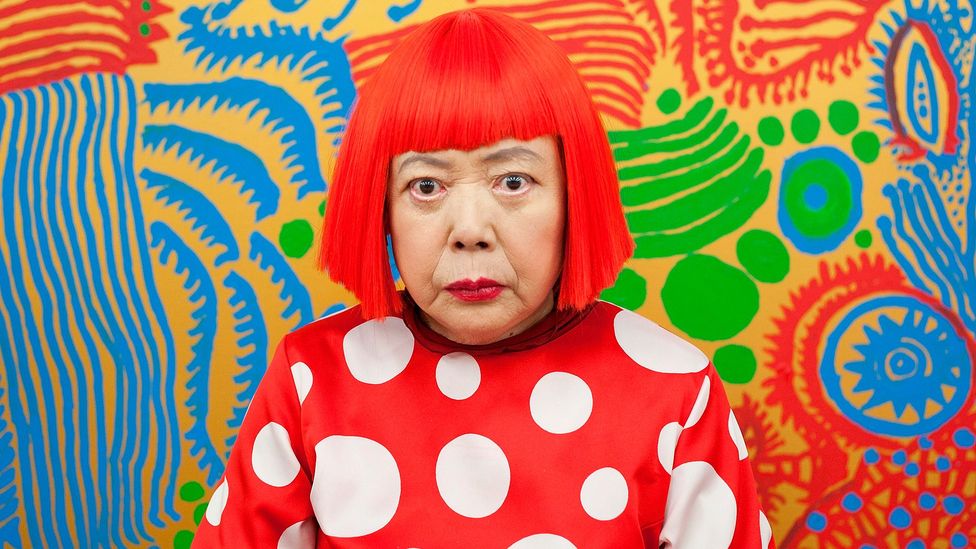
The Japanese artist famed for her Instagrammable artworks overcame babyhood trauma, prejudice and mental illness to become a awareness late in life, writes Cath Pound.
Y
Yayoi Kusama is the biggest-selling female creative person in the world. And in her bright-red wig and quirky polka-dot ensembles, she is also one of the most instantly recognisable. At virtually 90 years old she is notwithstanding astonishingly prolific. Her upcoming show at the Victoria Miro gallery in London is spring to draw crowds around the block, desperate to be photographed within her new, fabulously Instagrammable Infinity Room.
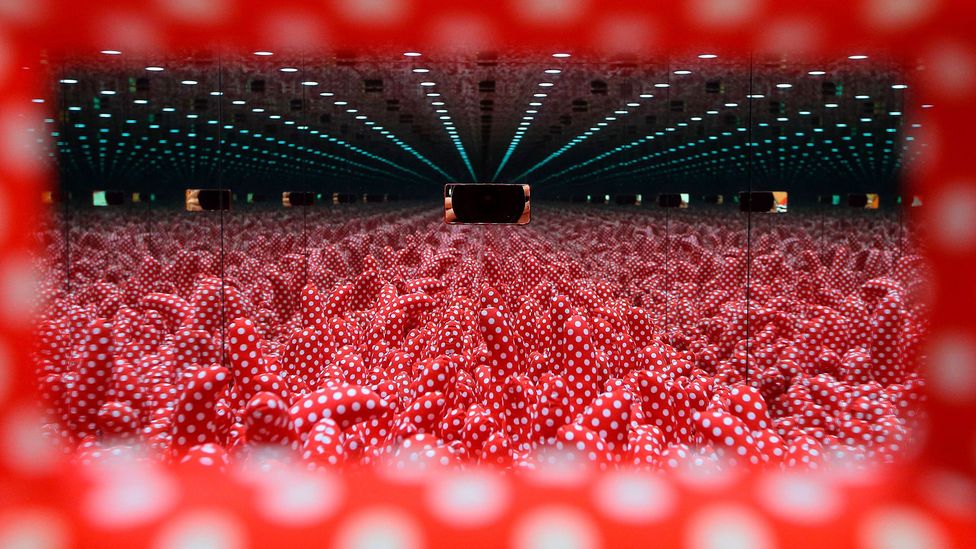
Yayoi Kusama'south exhibitions – including her Infinity Mirror Rooms – draw huge crowds and have proven wildly popular on Instagram (Credit: Getty)
But before reaching this exalted position Kusama had to endure babyhood trauma, and watch equally her ideas were brazenly stolen past her male peers, events which led to mental illness and suicide attempts. Her extraordinary story of survival is told in a fascinating new documentary, Kusama: Infinity.
- Eerie, hyper-real human sculptures
- The artist who triumphed over her rape
- The forgotten women of Impressionism
Kusama was born in 1929 in the rural provincial town of Matsumoto, Japan and from a young age was determined to be a painter. Her early works reveal what was to become an enduring fascination with both natural forms and polka dots, the latter allegedly actualization to her in a vision. However, her family unit were far from supportive. Equally Heather Lenz, the producer and manager of Kusama: Infinity explains, it was simply non the thing for a woman at that time to have career ambitions. "The expectation was that she would get married and have kids – and not just get married only have an arranged wedlock," she tells BBC Civilization.
Her mother snatched drawings from her before she was able to finish them, which may explain her obsessive creative drive as she rushes to stop a work before it can be taken from her. Frustrated at her hubby'south infidelity Kusama's mother would force her daughter to spy on him with his lovers. She found the feel so traumatic that she adult a lifelong aversion to sexual practice.
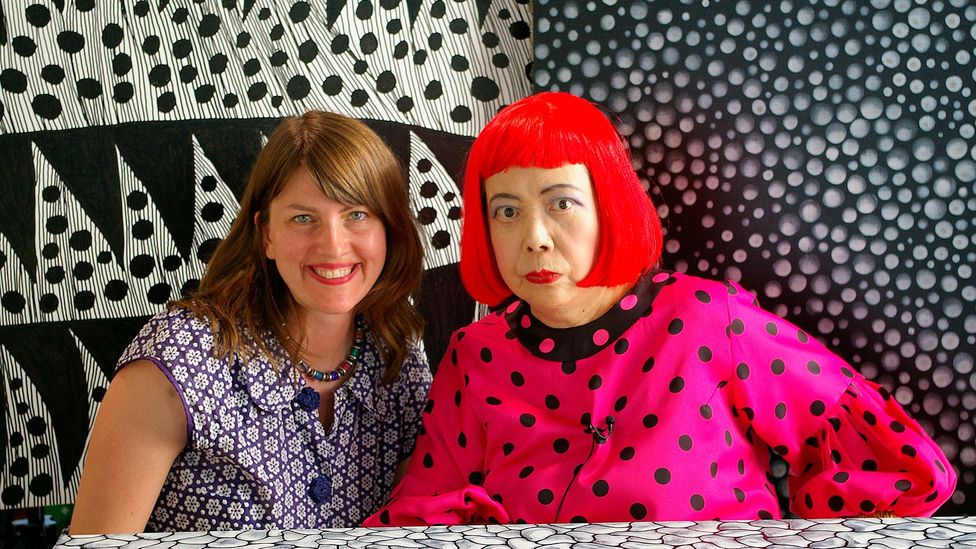
Heather Lenz – shown here with Kusama – is the director of a new documentary almost the artist (Credit: Tokyo Lee Productions)
Unsurprisingly, Kusama began to think of a means of escaping her stifling home environment. A great admirer of Georgia O'Keefe, in whose fantastical, dreamlike depictions of nature she saw a kindred spirit, she took the extraordinarily bold step of writing to her for advice. "I'1000 only on the get-go step of the long difficult life of being a painter. Will you kindly testify me the way?" she asked.
She must have been ecstatic when O'Keefe wrote back, even if information technology was to warn her that "In this country an artist has a hard fourth dimension making a living." All the same, she brash Kusama to come to the United states and show her work to anyone who might be interested.
At the time Kusama spoke very little English, and it was prohibited to send coin from Japan to the US. Undaunted, she sewed dollar bills into her kimono and ready off beyond the Pacific determined to conquer New York and make her name in the world.
Infinity and beyond
It was not to exist that easy. The New York fine art globe was male dominated to the extent that even many of the female dealers didn't desire to exhibit women.
Although Kusama won the praise of Donald Judd, a notable artist and critic, in an early review of her piece of work, and fifty-fifty though the painter Frank Stella was an admirer, existent success eluded her. A fact fabricated all the more agonising as she was forced to picket her male person peers gain recognition for her ideas.
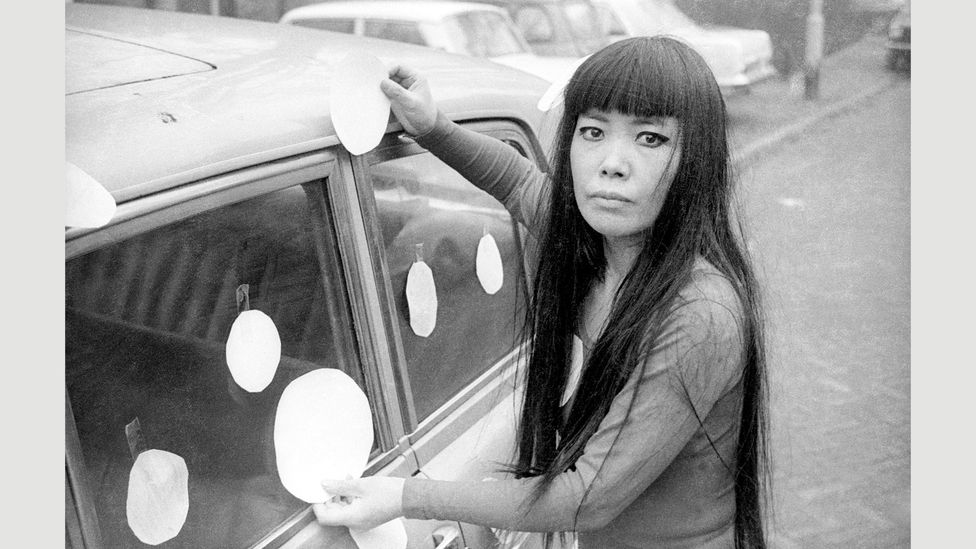
In her early years, Kusama was overlooked, watching every bit her male peers won fame for her ideas (Credit: Harrie Verstappen)
Claes Oldenburg was 'inspired' by her fabric phallic couch to start creating the soft sculpture for which he would become globe famous, while Andy Warhol would copy her innovative idea of creating repeated images of the sole exhibit in her Yard Boats installation for his Cow Wallpaper.
Just worse was to come. In 1965 Kusama created the earth'southward first mirrored-room environment, a forerunner to her Infinity Mirror Rooms, at the Castellane Gallery in New York. Equally homo prepared to head for the moon, Kusama had uniquely grasped the public's growing awareness of infinity. She confronted them with this unnerving concept through a seemingly endless environment.
But a few months later, in a complete modify of artistic direction, avant-garde creative person Lucas Samaras exhibited his own mirrored installation at the far more prestigious Pace Gallery.
Distraught and dejected, Kusama threw herself from the window of her flat.
With the support of friends such equally gallery possessor Beatrice Webb, she somehow managed to pull herself together and in a remarkable prove of decision took herself to the 1966 Venice Biennale, without invitation, to show her Narcissus Garden. A witty take on the commercialisation of the art world, information technology comprised 1500 mirrored balls that she sold off at a few dollars a time – until officials put a terminate to information technology.
"At this point she'due south no longer going to be a slave to the gallery system and have someone decide when and where she'll show her art," says Lenz.
Confronting her demons
Dorsum in the US, Kusama began staging happenings in newsworthy locations such as Central Park and the grounds of MoMa, often with the intention of promoting peace or criticising the art establishment. But the fact that many of these events involved nudity caused scandal dorsum home in Nippon and great shame to her conservative family. Even some elements of the United states of america press criticised what they saw as her endless want for publicity.
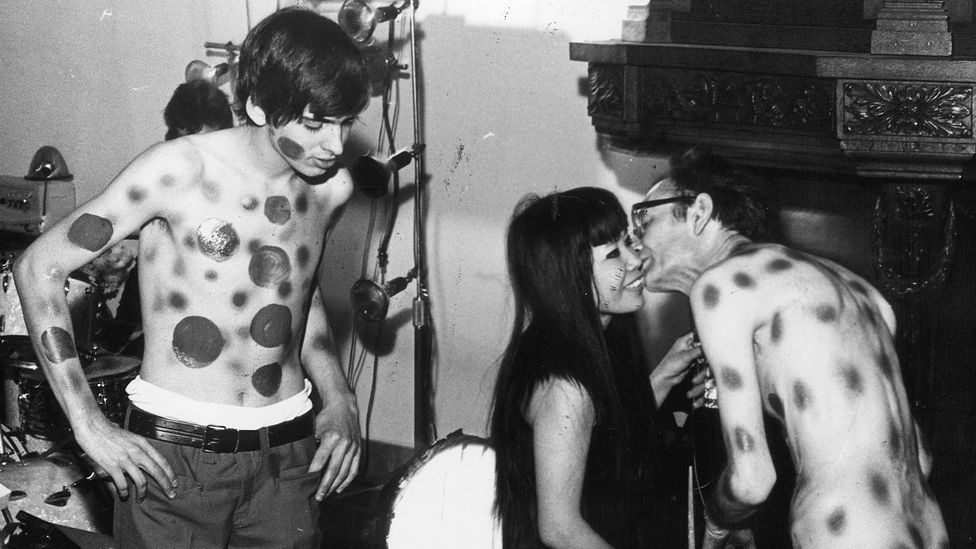
Frequent nudity in her works drew scorn in Kusama's native Japan and brought shame on her family (Credit: Getty)
Increasingly disillusioned and depressed she returned dwelling to Nihon where, without the support of family or friends and finding herself unable to paint, she once over again attempted suicide.
But information technology seems that Kusama's desire to create was always greater than her desire to die. Miraculously, she managed to detect a hospital where the doctors were interested in fine art therapy and checked herself in.
In this secure environment she constitute herself able to make art again. Her first works were an uncharacteristically dark series of collages in which she embraced the imagery of natural life cycles, almost equally if she was challenging herself to face up her demons.
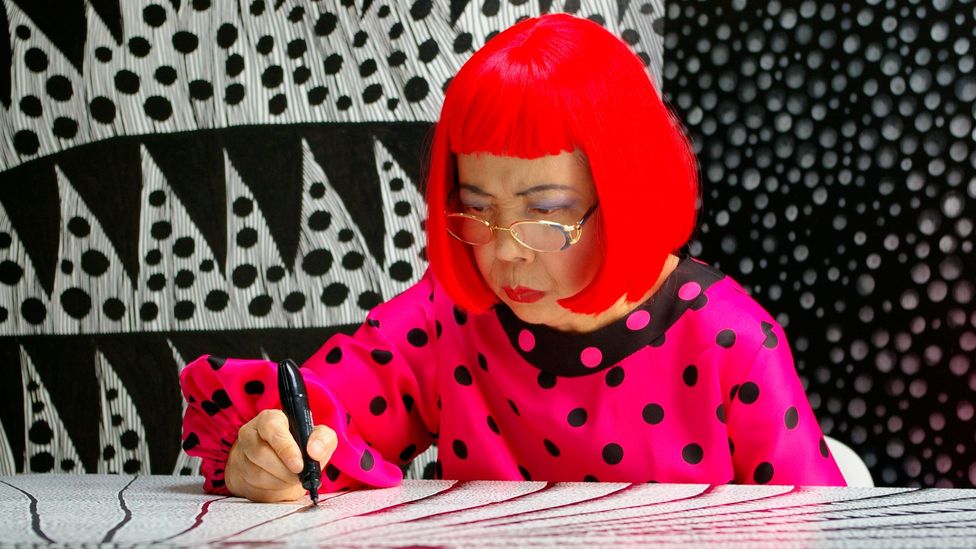
Kusama checked herself into a hospital that embraced art therapy – and began to rebuild her life and brand fine art once more (Credit: Tokyo Lee Productions)
By this indicate Kusama had been almost forgotten both at home and away but showing her enduring creative drive and determination she began to re-establish herself from scratch, and gradually her piece of work began to be re-evaluated. A retrospective of her piece of work was held at the Center for International Contemporary Arts in New York in 1989, and four years later on, the Japanese art historian, Akira Tatehata, managed to persuade the authorities that she should be the showtime solo artist to represent Nihon at the 1993 Venice Biennale.
Although a frail Kusuma had to exist accompanied past a psychotherapist, fearful of a nervous breakdown, the exhibition was a phenomenal success and led to a huge transformation in how she was received and recognised in Nihon.
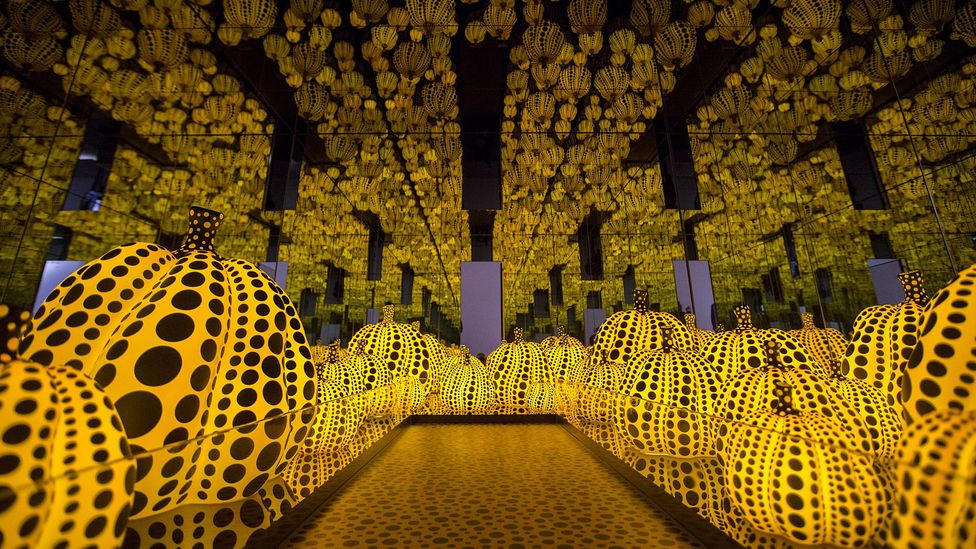
Kusama's piece of work was gradually re-evaulated – she is now the globe's biggest-selling female artist (Credit: Getty)
Further retrospectives followed while increasing recognition and her supportive environment immune Kusama to keep to transform her trauma into art. However, when Lenz began work on her documentary in 2001 Kusama's global reputation was still in its infancy. "Ironically I thought the film was going to bring her greater success," she laughs.
Kusama'south amazing rise in the intervening years owes much to social media just one hopes that the documentary volition encourage people to put down their phones and have time to properly reflect on her work next fourth dimension they become to see it. Whether viewing pumpkins, polka dots or immersed in ane of her awe-inspiring Infinity Rooms, what visitors are looking at is aught less than the redemptive power of art.
If you would similar to comment on this story or anything else you accept seen on BBC Culture, caput over to our Facebook page or message united states on Twitter .
And if you liked this story, sign up for the weekly bbc.com features newsletter , called "If Y'all Only Read 6 Things This Week". A handpicked choice of stories from BBC Time to come, Culture, Capital and Travel, delivered to your inbox every Friday.
Source: https://www.bbc.com/culture/article/20180925-yayoi-kusamas-extraordinary-survival-story
0 Response to "Asian Art Work of People Being Beaten by Women"
Post a Comment